The Drama of the Solar System — Final Scene

POST 4:: #astronomyatschool #astronomywithrahul #astronomy #sciencepopularization #popularscience #CosmosMusings

Listen to the blog on the go. Listening time 9:35|Original background music: Ishanee Chatterjee

There are a few questions that are often asked by children during the interactive session after a popular lecture. The two most common are (1) How and when will the world come to an end and (2) Are we alone in the universe.

So, that is what I will be doing today – discussing in a popular way, the final scene in the drama of the solar system and leave the second question for a later post. And if any of you is saying “I know this answer”, wait! There are two competing events.

Our life on earth is intricately entwined to the governor of the solar system – the Sun. The day the Sun ends its life, will also be the day life on Earth will come to an end or at the most, begin to come to an end.

When we look up at the night sky, we see little specks of light as if studded on a hemispherical dark canvas. In truth, neither are the stars all at the same distance away from us, nor are they the same size. Nature really has made all varieties of stars possible. While there are stars as small as about one-third the mass of our Sun, the other extreme takes us to astonishingly large stars, some even a few thousand times bigger than our sun! Then again, many of the stars have planets revolving around them like our sun and then there are systems of double and multiple stars which have planets revolving around them! What fun it would be to have multiple sunrises and sunsets, and how beautiful it would be! But that’s a story for another occasion.
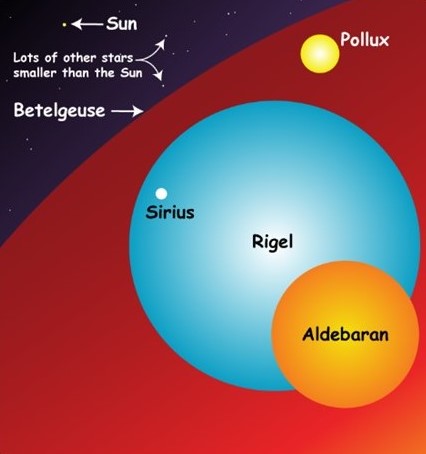
Comparison of Sun’s size :: Source: https://spaceplace.nasa.gov/sun-compare/en/

When a star initially forms from a collapsing molecular cloud due to mass accretion, it contains primarily hydrogen and a little bit of helium. As the star grows in mass, gravity crushes the gases tighter and as a result the temperature at the core rises. When the core reaches a temperature high enough to begin fusing hydrogen, which is a few million kelvin, it establishes hydrostatic equilibrium. This is a state when the inward pressure due to gravity is counter balanced by the outward pressure due to the hot gases. The star slowly converts the hydrogen in the core into helium through nuclear fusion, during its lifetime.  Once all the hydrogen is fused into helium, its main-sequence life will end. This will take about 10 billion years for our Sun. Heavier stars burn much faster, converting more mass into energy per second and so, have a shorter lifetime than lighter stars.

Thus, the fate of a star is determined by its initial mass. The evolution and final death of a star takes a route depending on its initial mass. Stars that are 0.3 to 8 solar masses, and are in the final stages of stellar evolution are typically what we call Red Giant Stars. Our Sun will end as a Red Giant. In Red Giant stars, hydrogen has been used up and converted to helium in the core. The temperature not being high enough for the fusion of helium to take place, the reaction stops and the core begins to cool. Gravity had patiently been waiting for this opportunity. Throughout the life of a star, it is a dynamic tussle between gravity trying to pack the star into a tighter, denser ball and the hot gases in the core trying to prevent the crushing, thus achieving what is called the hydrostatic balance. When the fusion reaction stops, the outward pressure weakens and gravity crushes the star into a tighter mass. The layer just outside the core now has conditions to start fusion of hydrogen. But because the inner core has collapsed, the outer layers must expand in order to satisfy simultaneous conservation of gravitational and thermal energy in the star.

For the Sun and stars of less than about two solar masses, gravity will crush the core to become dense enough, so that electron degeneracy pressure will prevent it from collapsing further. This collapse will further heat the core to about 10^8 K, hot enough to begin fusing three helium nuclei to carbon. For stars of mass upto two solar masses, a beautiful phenomenon happens at this point. When the degenerate core reaches this temperature of 10^8 K the entire core will begin helium fusion nearly simultaneously in a phenomenon called helium flash. In heavier stars, the collapsing core reaches 10^8 K before it is dense enough to be degenerate and so helium fusion begins much more smoothly and there is no helium flash.

The obvious question that would come to your mind is whether the core will again collapse and the next higher order of reactions also start when helium is exhausted. A star below about eight solar masses will never start fusion in its degenerate carbon–oxygen core.  It will eject its outer layers, setting off the red giant phase in all its glory. When it happens to our Sun, the expanding clouds of gas will consume the inner planets. The core of the star will become a white dwarf. The carbon rich core, crushed under pressure and heat converts into diamond over time and the sky is filled with such huge masses of pure diamond!

At this stage, the Sun will no longer produce heat and light at the rate it is now. The Earth will become a freezing dark place. Moreover, the Sun having lost a lot of its mass, will not have the same gravitational pull on the planets. The planets will fly tangentially off from their orbits into new orbits or may even be lost for ever.
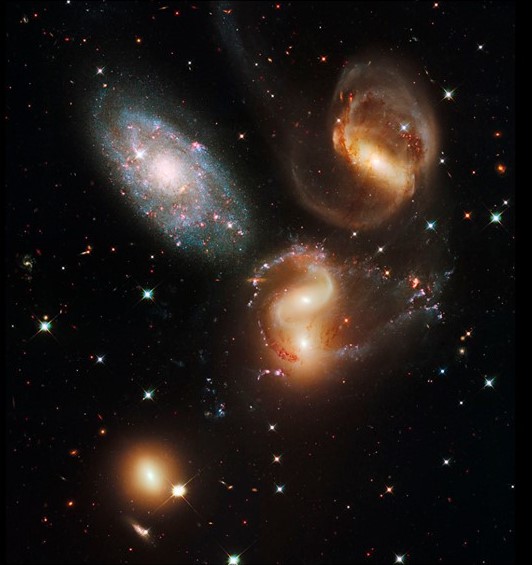
Stephen’s Quintet Source:https://en.wikipedia.org/wiki/Stephan%27s_Quintet#/media/File:Stephan’s_Quintet_Hubble_2009.full_denoise.jpg

Worried? Don’t be. This is going to take about another five to six billion years. But much before that, in about four billion years, there is another gigantic event that is going to happen to not only the solar system, but to the entire Milky Way Galaxy! The Andromeda Galaxy and the Milky Way Galaxy are hurtling towards each other at a tremendous speed of about 402,000 Km/hr! At present they are about 2.5 million light years apart, and even at that fantastic speed, their cores won’t meet in another four billion years, even though scientists believe the edges of the two galaxies are already almost touching! But when they do meet, what will happen to the stars of the Milky Way is difficult to predict. Though the possibility of head-on collisions of the outer regions is very small, given the large distances between stars in both systems, the possibility of stars and accompanying planetary systems being thrown about and tossed in space is not unlikely! But the cores of the two galaxies being very densely packed, pose a real possibility of collisions and mega “fireworks” in the sky. The tremendous pressures and temperatures that will be created will certainly not be conducive for any life as we know, to survive. Is this the only example of interacting galaxies? No. There are many interacting galaxies. The famous Stephen’s Quintet has five interacting galaxies. There are also examples of galaxies which have met and merged.

Collision of Galaxies :: Source NASA – http://www.nasa.gov/mission_pages/hubble/science/milky-way-collide.html

Are such events spoilers for life then? No! These are the very events along with supernova explosions that seed space with the right kind of material for life to start! Out of chaos comes order.
Saturn & Enceladus, an endearing relationship

Post 3:: #astronomyatschool #astronomywithrahul #astronomy #sciencepopularization #popularscience #CosmosMusings

Listen to this blog on the go. Listening time 7:16 | Original background music by Ishanee Chatterjee

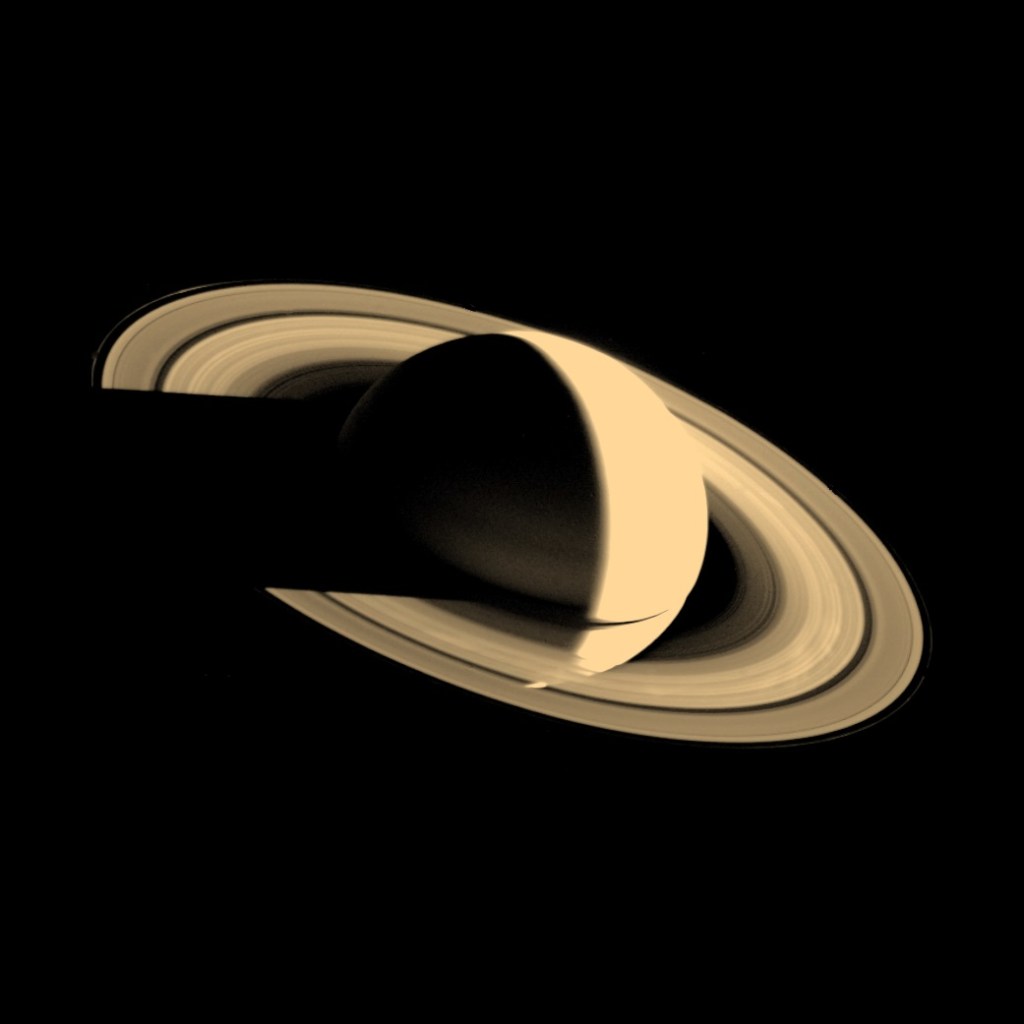
My fascination with Saturn will never ebb. Ever since I saw the last picture of Saturn taken by the Voyager spacecraft, years ago, I’ve just fallen in love with the planet! So many times it has happened during a popular lecture that it took me a few seconds to start saying what I wanted to say when in the ppt presentation a full slide picture of Saturn was splashed on a giant screen behind me – I turned back to see the screen and was lost for words…

The last picture of Saturn taken by Voyager.

Source: https://www.google.co.in/search?source=univ&tbm=isch&q=saturn+picture+by+voyager&sa=X&ved=2ahUKEwjYhdq9scfqAhWGILcAHde-BT4QsAR6BAgEEAE#imgrc=mPKNfDKW-JnegM

Saturn is a mini solar system on its own. It has 82 moons of which 53 are confirmed and named and 29 are awaiting confirmation of their discovery and official naming. Titan is the largest moon of Saturn and is larger than planet Mercury. Some moons of Saturn are as small as a football field. The moons have a very dynamic relation with its spectacular rings. They give it shape, contribute to it or even take from it! My focus today is on one specific moon of Saturn – Enceladus. But I’ll come to that a little later.

The structure that makes Saturn most spectacular visually, is its system of rings. The rings have been named using the letters of the English alphabet in the order in which they were discovered. While the D Ring is nearest to Saturn, E Ring is the last but one ring at a distance of about four Saturn radii! Naturally, the first few to be discovered were also the brightest ones. Ring E is one of the faintest, and is also my focus today. 

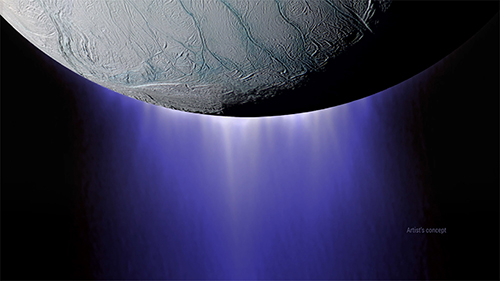
The plumes of Enceladus that has created and maintain the E Ring of Saturn.

Pic Source: https://solarsystem.nasa.gov/missions/cassini/science/enceladus/


The E ring was discovered in 1966 during the ring plane crossing and observed again in 1980. From these observations, it was clear that the colour of the E Ring was distinctively blue. The peak brightness of the E Ring occurs at 235,000 km, coinciding with the orbit of Enceladus. The E Ring ranges from a distance of 180,000 Km to 480,000 Km from Saturn. (For comparison, our moon is at a distance of 380,000 Km approximately from the earth).

When the E ring was being observed and studied, scientists noticed that the ring would lose its thickness over some time. But what intrigued them was that the ring would regain its thickness and luminosity as if someone was sprinkling gold-dust along the ring to revive it all over again! This puzzled them for a long time.  The vertical thickness of the ring is smallest at Enceladus’ orbit (and hence the densest), with the ring puffing up noticeably at larger distances to 15,000 km or more thick. Let me leave this question here for the moment. I’ll come back to it in a jiffy. I want to talk of Enceladus now, which I had started.

The comparatively smooth surface of Enceladus indicates that the surface is being refreshed, thus erasing the old craters.

Pic Source: https://en.wikipedia.org/wiki/Enceladus#/media/File:Enceladusstripes_cassini.jpg


Enceladus was discovered in 1789, by William Herschel. Even the flybys of Voyager 1 and Voyager 2, in 1980 and 1981 did not provide fine details of it. In 2005, the Cassini spacecraft started multiple close flybys of Enceladus, revealing its surface and environment in greater detail. Cassini discovered water-rich plumes being vented out from the south polar region of Enceladus. These geyser-like jets of water shoot out 200 to 250 Kg of water per second into space with speeds up to 2,189 km/h containing water vapor, carbon dioxide, methane, perhaps a little ammonia and either carbon monoxide or nitrogen gas making up the gaseous envelope of the plume, along with salts and silica. These jets are vented out from fissures on the south polar surface of Enceladus, popularly referred to as “Tiger Stripes”. More than 100 jets have been identified. The “salty” particles being heavier, fall back on Enceladus while the lighter fresh water particles escape the gravitational pull of Enceladus. These fresh water particles deposit themselves along the E ring, forming the E ring and replenishing it. To maintain such a huge supply of water jet, there must be a huge stock of water. Different calculations have shown that Enceladus has a global ocean beneath the icy crust and has a depth of 26 to 31 km! (For comparison, Earth’s oceans have an average depth of 3.7 Km).

Thermal pictures of the Tiger Stripes show clearly the higher temperature in these vents.

Pic Source: https://en.wikipedia.org/wiki/Enceladus#:~:text=Enceladus%20%2Fɛnˈs,bodies%20of%20the%20Solar%20System.


The E ring is mostly made of ice droplets, but among them are nano-grains of silica, which can only be generated where liquid water and rock interact at temperatures above about 90 degrees Celsius. This, points to hydrothermal vents deep beneath Enceladus’ icy shell. The source of the thermal energy is thought to be a combination of tidal energy and radioactive decay.

Think about this: A tiny little world far out in the solar system where surrounding temperatures are way below -200 degree C, having an ocean of water deeper than that on Earth, and where there is hydrothermal activity at temperatures greater than 90 degrees C, which spew out huge volumes of water which turn into ice particles forming the E Ring! So much is happening and so beautiful the process and the result…

Nature never ceases to thrill !

Mercury was recently retrograde. What does it mean?

Post 2 :: #astronomyatschool #astronomywithrahul #astronomy #sciencepopularization #popularscience

Men have been looking up at the skies ever since they roamed the earth. Intelligent ancient civilizations like the Indians, Egyptians, Arabs, Mayans and others noticed certain ‘stars’ were brighter than the others and that they moved across the sky night after night. These moving stars were called planets. But something was very puzzling about them. At times these planets seemed to slow down, then move backwards and then would go forwards again! This apparent backward motion is called retrograde. Mercury is a good candidate for retrograde motion.
The scientific explanation for the phenomenon did not come until Nicolaus Copernicus came up with his heliocentric theory. (which says that the sun is at the centre of the solar system, with the planets going around it). To understand retrograde motion, let’s start with the “Right Hand Rule”.
Imagine that you hold your right hand out and make a fist with your thumb pointing upwards. The direction in which the thumb points, represents the direction of the Sun’s north pole and the direction in which the fingers wrap around, represents the direction in which the planets move around the sun. (Have you ever wondered why all the planets revolve around the sun in the same direction? The laws of physics would not be violated even if a planet revolved the other way round!)
The explanation to retrograde motion lies in the understanding of relative motion. When your car is overtaking another car, doesn’t the other car seem to be moving backwards? And if the other car speeds up, then you see it as going forwards. The same is true for Earth and Mercury. The average orbital speed of Mercury is much higher than that of the earth, and the shape of the orbit is quite elliptical. Most of the time Mercury is travelling much faster than the Earth, except when Mercury is near the extreme end of its elliptical orbit, i.e., when it is farthest from the sun. That’s when Mercury slows down a bit and the earth kind of catches up. So, this is the time when the Earth is overtaking Mercury and Mercury seems to move backwards. But is it really moving backwards? No ! It just appears that way because of our relative motions. This apparent backward motion is referred to as retrograde motion. So, will other planets also display retrograde motion?

Retrograde motion of Mars

Mercury will be in retrograde in 2020 between the following dates:
February 17 to March 10; June 18 to July 12; October 14 to November 3

Astrologers, (not astronomers) ascribe such periods to periods of confusion simply because there was confusion in the understanding of the phenomenon at one point of time. They would advise you not to take major decisions in these periods. Now that you know the science, you take your own decision! 🙂 Think if there is any real logical connection between superstitious beliefs and the real science.

Watch the clip I’ve attached and the picture to understand better.
The clip has been edited from https://www.youtube.com/watch?v=FtV0PV9MF88 and the picture taken from https://astrobob.areavoices.com/…/mars-is-close-bright-and…/