Post 3:: #astronomyatschool #astronomywithrahul #astronomy #sciencepopularization #popularscience #CosmosMusings
Listen to this blog on the go. Listening time 7:16 | Original background music by Ishanee Chatterjee
My fascination with Saturn will never ebb. Ever since I saw the last picture of Saturn taken by the Voyager spacecraft, years ago, I’ve just fallen in love with the planet! So many times it has happened during a popular lecture that it took me a few seconds to start saying what I wanted to say when in the ppt presentation a full slide picture of Saturn was splashed on a giant screen behind me – I turned back to see the screen and was lost for words…
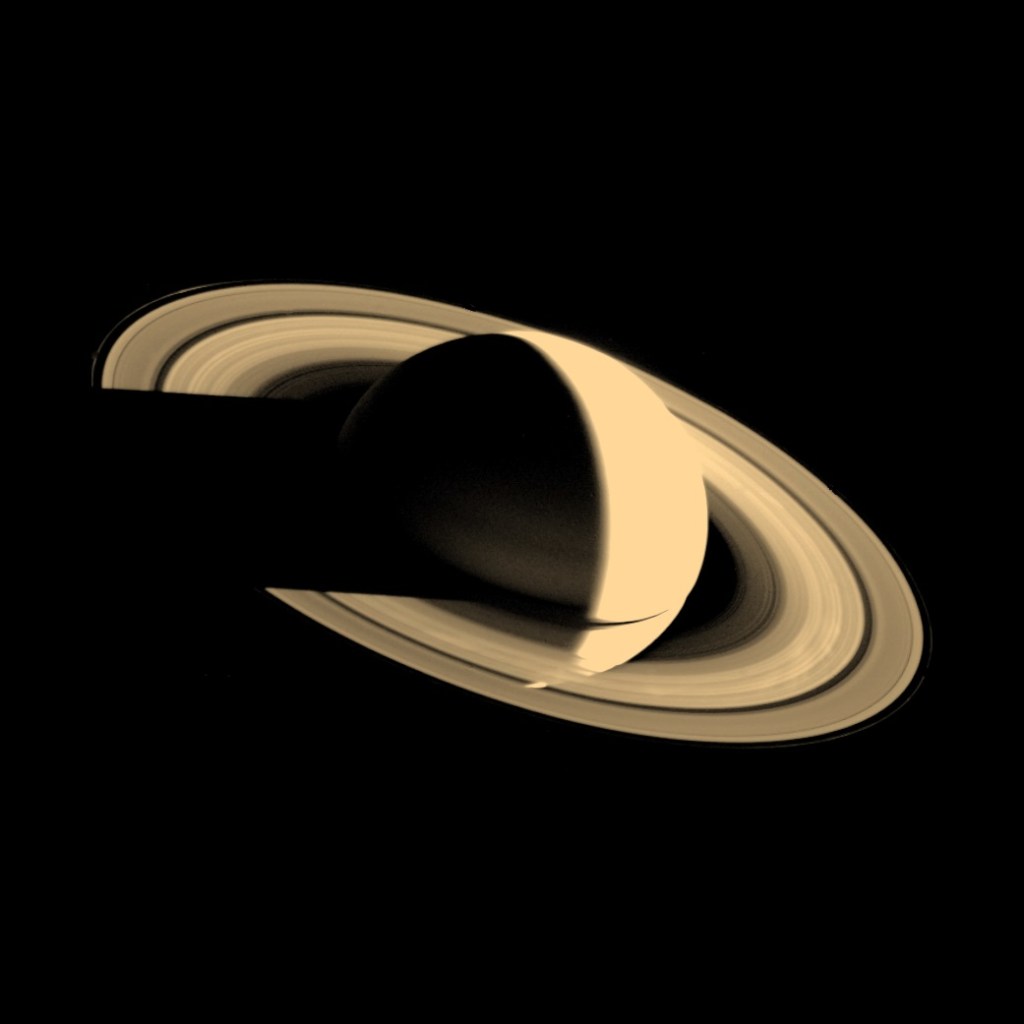
Source: https://www.google.co.in/search?source=univ&tbm=isch&q=saturn+picture+by+voyager&sa=X&ved=2ahUKEwjYhdq9scfqAhWGILcAHde-BT4QsAR6BAgEEAE#imgrc=mPKNfDKW-JnegM
Saturn is a mini solar system on its own. It has 82 moons of which 53 are confirmed and named and 29 are awaiting confirmation of their discovery and official naming. Titan is the largest moon of Saturn and is larger than planet Mercury. Some moons of Saturn are as small as a football field. The moons have a very dynamic relation with its spectacular rings. They give it shape, contribute to it or even take from it! My focus today is on one specific moon of Saturn – Enceladus. But I’ll come to that a little later.
The structure that makes Saturn most spectacular visually, is its system of rings. The rings have been named using the letters of the English alphabet in the order in which they were discovered. While the D Ring is nearest to Saturn, E Ring is the last but one ring at a distance of about four Saturn radii! Naturally, the first few to be discovered were also the brightest ones. Ring E is one of the faintest, and is also my focus today.
Pic Source: https://solarsystem.nasa.gov/missions/cassini/science/enceladus/
The E ring was discovered in 1966 during the ring plane crossing and observed again in 1980. From these observations, it was clear that the colour of the E Ring was distinctively blue. The peak brightness of the E Ring occurs at 235,000 km, coinciding with the orbit of Enceladus. The E Ring ranges from a distance of 180,000 Km to 480,000 Km from Saturn. (For comparison, our moon is at a distance of 380,000 Km approximately from the earth).
When the E ring was being observed and studied, scientists noticed that the ring would lose its thickness over some time. But what intrigued them was that the ring would regain its thickness and luminosity as if someone was sprinkling gold-dust along the ring to revive it all over again! This puzzled them for a long time. The vertical thickness of the ring is smallest at Enceladus’ orbit (and hence the densest), with the ring puffing up noticeably at larger distances to 15,000 km or more thick. Let me leave this question here for the moment. I’ll come back to it in a jiffy. I want to talk of Enceladus now, which I had started.

Pic Source: https://en.wikipedia.org/wiki/Enceladus#/media/File:Enceladusstripes_cassini.jpg
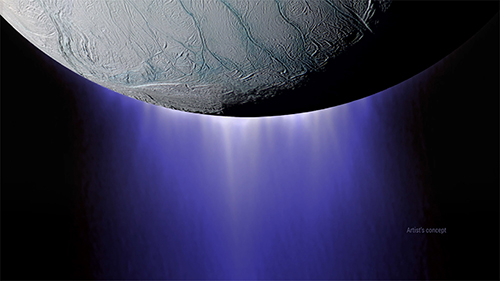
Enceladus was discovered in 1789, by William Herschel. Even the flybys of Voyager 1 and Voyager 2, in 1980 and 1981 did not provide fine details of it. In 2005, the Cassini spacecraft started multiple close flybys of Enceladus, revealing its surface and environment in greater detail. Cassini discovered water-rich plumes being vented out from the south polar region of Enceladus. These geyser-like jets of water shoot out 200 to 250 Kg of water per second into space with speeds up to 2,189 km/h containing water vapor, carbon dioxide, methane, perhaps a little ammonia and either carbon monoxide or nitrogen gas making up the gaseous envelope of the plume, along with salts and silica. These jets are vented out from fissures on the south polar surface of Enceladus, popularly referred to as “Tiger Stripes”. More than 100 jets have been identified. The “salty” particles being heavier, fall back on Enceladus while the lighter fresh water particles escape the gravitational pull of Enceladus. These fresh water particles deposit themselves along the E ring, forming the E ring and replenishing it. To maintain such a huge supply of water jet, there must be a huge stock of water. Different calculations have shown that Enceladus has a global ocean beneath the icy crust and has a depth of 26 to 31 km! (For comparison, Earth’s oceans have an average depth of 3.7 Km).

Pic Source: https://en.wikipedia.org/wiki/Enceladus#:~:text=Enceladus%20%2Fɛnˈs,bodies%20of%20the%20Solar%20System.
The E ring is mostly made of ice droplets, but among them are nano-grains of silica, which can only be generated where liquid water and rock interact at temperatures above about 90 degrees Celsius. This, points to hydrothermal vents deep beneath Enceladus’ icy shell. The source of the thermal energy is thought to be a combination of tidal energy and radioactive decay.
Think about this: A tiny little world far out in the solar system where surrounding temperatures are way below -200 degree C, having an ocean of water deeper than that on Earth, and where there is hydrothermal activity at temperatures greater than 90 degrees C, which spew out huge volumes of water which turn into ice particles forming the E Ring! So much is happening and so beautiful the process and the result…
Nature never ceases to thrill !
 CosmosMusings